Designed by Janusz Rudnicki
QuickWave
software for electromagnetic design
Copyright © 2008 by
QWED
All Rights reserved
info@qwed.eu

Updated: March 26, 2008
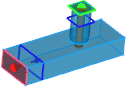
Fig. 1. General view of the structure
Microstrip-to-waveguide transition
 
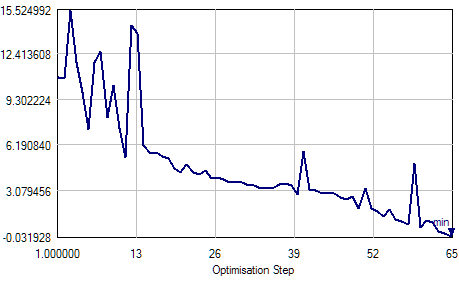
Fig. 3. Optimisation progress
Fig. 2. Objective and variables defined for optimisation
The objective function to be used in optimization is |S11| and we will try to get the input reflection below 0.01 in the frequency sub-range between 10 and 12GHz. There are six variables used in optimisation.
Waveguide horn - rectangular waveguide horn in a metal block (vertical) with absorbing and NTF
It concerns a flat waveguide horn excited by the dominant waveguide mode. An air-filled horn is assumed to be radiating from a block of metal (shown grey, semi-transparent). In the optimisation process, we will be changing the horn length (in vertical z-direction) as well as its width (in x-direction) and height (in y-direction). We will try to achieve good antenna gain for the frequency 24 GHz in the lobe of 0 ± 18° (in zx-plane) as well as good matching with |S11|<0.08 in the frequency range from 23.5 to 24.5 GHz.
Fig. 4. General view of the structure
Fig. 5. Optimisation progress
 
Optimisation
Microstrip-to-waveguide transition
Waveguide horn
Click here to read about QW-OptimiserPlus
Axisymmetrical corrugated horn
(V2D example)
 
Axisymmetrical corrugated horn - V2D example
Four objective functions are used in optimisation:
·
|S11| in the band of 10.5 to 11.5 GHz is supposed to be as low as possible but any value below 0.05 is acceptable
·
the Copolar45 relative gain in the range of angles between 0º and 45º should be higher than 0.3
·
the Copolar45 relative gain in the range of angles between 45ºand 180º should be smaller than 0.33
· the Crosspolar45 relative gain in the range of angles between 0º and 180º should be smaller than 0.05
Fig. 6. Axisymmetrical corrugated horn antenna model.
Fig. 7. Optimisation progress