Designed by Janusz Rudnicki
QuickWave
software for electromagnetic design
Updated: April 14, 2008
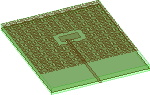
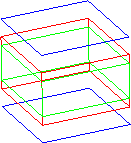
Fig.6. Circular patch antenna model
Fig. 7. Radiation patterns versus elevation angle Theta with azimuthal angle Phi=0,
calculated for two frequencies: 2.65 and 5.575 GHz.
Fig. 8. Radiation patterns versus azimuthal angle Phi with elevation angle Theta=30°,
calculated for two frequencies: 2.65 and 5.575 GHz
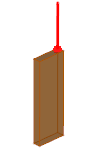
Circular Patch Antenna - a circular patch fed by a thin vertical coax line
Wire Antenna - a simplified model of a mobile handset with a wire antenna. The structure has been originally measured by Jensen and Rahmat-Samii and presented in "Performance analysis of antennas for hand-held transceivers using FD-TD", IEEE Trans. Antennas Propag., vol. AP-42, No.8, Aug.1994, pp.1106-1113.
Fig. 9. Simplified handset model
Fig. 10. Radiation patterns obtained versus angle Theta for Phi=90° with reference axis Z, i.e., in zy-plane,
for two frequencies: 0.915 and 0.94 GHz
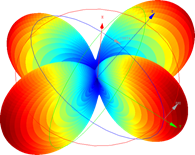
Fig. 11. 3D radiation pattern calculated for 0.915 GHz
Axisymmetrical Corrugated Horn Antenna (V2D example)
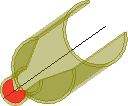
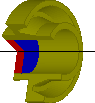
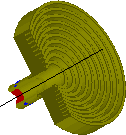
Fig. 3. Axisymmetrical corrugated horn antenna model
Fig. 5. Radiation patterns obtained versus angle Theta for 20 GHz
Fig. 4. Ephi field in antenna
Dual reflector antenna - (V2D example) large model exceeds capabilities of 3D solvers
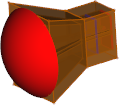
Fig. 1. Dual reflector antenna model
Fig. 2. Hphi in antenna
Near-to-Far transformation at the fixed angle, in time-as well as frequency-domain
Starting with the version 7.0 of QuickWave-3D there is another postprocessing allowing the far field radiation analysis, called NTF at Fixed Angle (NTFFA). Sometimes, especially in radar applications, our aim is to control the shape of the pulse as well as its spectrum in the far zone at the particular direction from the transmitting antenna - rather than the radiation characteristic over a range of angles, at a few fixed frequencies. This would be very time-consuming to obtain with NTF transform described in the Section 2.3.1 of the User Guide since it performs a Fourier transform of the electromagnetic field at the NTF box followed by near-to-far transformation in the frequency domain. To the contrary, NTF at Fixed Angle performs the near-to-far transformation in the time domain, directly from the time-domain fields at the NTF box. The far-field results is then Fourier-transformed. Let us look at example, i.e. horn1_ntffa.pro to clarify the main features of this new postprocessing.
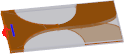
Fig. 12. Rectangular waveguide horn antenna model
The antenna is excited with TE10 mode within the 18 - 30 GHz band. We want to observe the radiated impulse in the far zone exactly in front of the antenna. We use one NTF box to define both NTF and NTFFA postprocessings which may work simultaneously. Let us then invoke Processing/Postprocessing window and focus on the NTF FixAng. section. In the first line we set the spectrum of the Fourier transform to be performed on the far zone signal. In the second line we specify all the directions of interest in the following manner:
j1 Q1; j2 Q2; …
where j and Q are the azimuthal and elevation angles (in degrees) of the spherical coordinate system with the Z-axis as a reference (Q is measured from the Z-axis and j is measured from the X-axis in the XY-plane).
Fig. 13. Processing/Postprocessing dialogue in the example horn1_ntffa.pro
We may observe the pulse in the far zone, as a function of time.
Fig. 14. Envelope window in the example horn1_ntffa.pro
When the pulse eventually fades away, we may look at its Fourier transform. Both instantaneous far field and its Fourier transform calculated with NTFFA are in sqrt(W)/m units, similarly like in NTF Fields at 1m. Therefore, we may directly compare the NTF and NTFFA results. In particular, note that the value of |Ephi| at 20 GHz in the direction of j=0 deg and Q=0 deg is 0.89 sqrt(W)/m in both NTF (Fig. 16) and NTFFA (Fig. 15) postprocessing.
Fig. 15. Antenna Fixed Angle Results window in the example horn1_ntffa.pro
Fig. 16. Antenna Results window in the example horn1_ntffa.pro
Let us then invoke NTF results and look at the peak value of the main lobe in Fields at 1m scale. For both 20 and 25 GHz frequencies discrepancy is about 1% what apparently results from different approaches incorporated in both postprocessings.
Near-to-Far transformation at the fixed angle with symmetry
The NTFFA postprocessing may operates with magnetic and/or electric symmetries in -X -Y and -Z direction. To show how it works let us look at the 1dipe_ntffa.pro example. Dipole is located near the electric wall and is excited with a Gaussian pulse of finite duration and frequency around 10 GHz. Regarding NTFFA postprocessing, we have set the observation direction to (j, Q) = (0 deg, 90 deg) to watch the far field response perpendicularly to the ground plane.
As expected, we first observe the main pulse radiated directly by the dipole. Due to reflection from the electric symmetry plane, it is followed by its out-of-phase image. The time shift between the two pulses is shown in Fig. 19 as t_shift=0.800554 ns. Since the distance between the dipole and the symmetry plane is 120 mm, the time shift should be 0.8 ns. The difference between the analytically expected and numerically captured time shift is within the display resolution being the FDTD time step (0.00333564 ns).
Fig. 17. Envelope window in the example 1dipe_ntffa.pro
We may look at the Fourier transform of the far field response before and after the reflected pulse is detected (Fog. 18). When only the direct pulse is detected, the spectrum is nearly Gaussian (corresponding to the Gaussian excitation but with maximum shifted above 10 GHz due to higher radiation resistance at higher frequencies). When both direct and reflected signals reach the observation point, several minima occur. For example, at 10 GHz the distance between the dipole and the electric symmetry is 4 wavelengths. Since the reflection introduces a phase-shift by 180 deg, the two signals cancel out. This also happens at other frequencies where the dipole to symmetry distance is a multiple of half-wavelength.
Fig. 18. Antenna Fixed Angle Results window in the example 1dipe_ntffa.pro (it=408 and 839)
The opposite behaviour is observed when the magnetic wall is set instead of the electric one. The main and reflected signals are in phase (Fig. 19) and there are maxima of the Fourier transform at frequencies where the dipole to symmetry distance is a multiple of half-wavelength (Fig. 20).
Fig. 19. Envelope window in the example 1dipm_ntffa.pro
Fig. 20. Fixed Angle Results window in the example 1dipm_ntffa.pro (it=408 and 839)